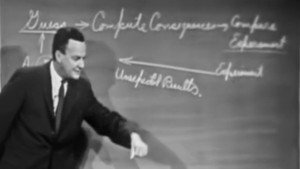
S1 · E1 — The Law of Gravitation - An Example of Physical Law
Up next·S1 E2
The Relation of Mathematics to Physics
In this lecture, Dr. Richard Feynman explores the relationship between mathematics and physics. He discusses the use of mathematics, ist power as a reasoning tool, the two traditions in science, and the fact that pursuits in physics have many possible starting points.
Continue the story
Episodes
Now playing
The Law of Gravitation - An Example of Physical LawE1 · 45 min
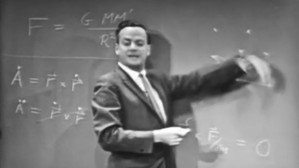
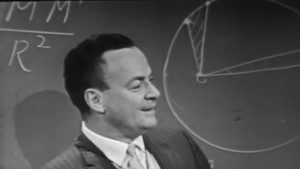
After a brief introduction by Dale Corson, Dr. Richard Feynman discusses the physical law of gravity. He covers its origins through scientific discoveries in astronomy and also Newton's contribution. He then discusses its implications and relationship to other laws.
The Relation of Mathematics to PhysicsE2 · 45 min
In this lecture, Dr. Richard Feynman explores the relationship between mathematics and physics. He discusses the use of mathematics, ist power as a reasoning tool, the two traditions in science, and the fact that pursuits in physics have many possible starting points.
The Great Conservation PrinciplesE3 · 45 min
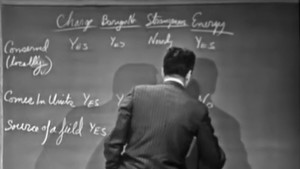
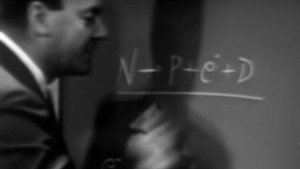
In this lecture, Dr. Richard Feynman discusses the great conservation principles including those related to electric charge, baryons, strangeness, energy, and angular momentum. He also discusses locality and the principle of relativity.
Symmetry in Physical LawE4 · 45 min
In this lecture, Dr. Richard Feynman discusses symmetry in physical law. He covers translation in space, translation in time, rotation in space, the principle of relativity, symmetry in atomic particles, changes in scale, uniform angular speed, and reflection in space. He also discusses the relationship between conservation laws and symmetry, and concludes with a brief look at antimatter.
The Distinction of Past and FutureE5 · 45 min
In this lecture, Dr. Richard Feynman discusses the linearty of time, and its irreversible nature. He discusses the related topics of order and disorder, equilibrium, and how these relate to phenomena in our universe.
Probability and UncertaintyE6 · 45 min
In this lecture, Dr. Richard Feynman discusses the peculiarities of physics at the quantum level. He uses the classic double-slit experiment to illustrate the odd behavior of electrons and photons, and what scientists have learned about the way the universe works at such a small scale.
Seeking New LawsE7 · 45 min
In this lecture, Dr. Richard Feynman explores the process by which new laws of nature are discovered. He discusses the fundamental constituents of matter, and how scientists use various methods to attempt to discover new laws.
 Now playing